
Korea EEG Comparison Highlights Measurable Brain-Activity Shifts After 10 Minutes In EES, Sparking Calls For Controlled Replication
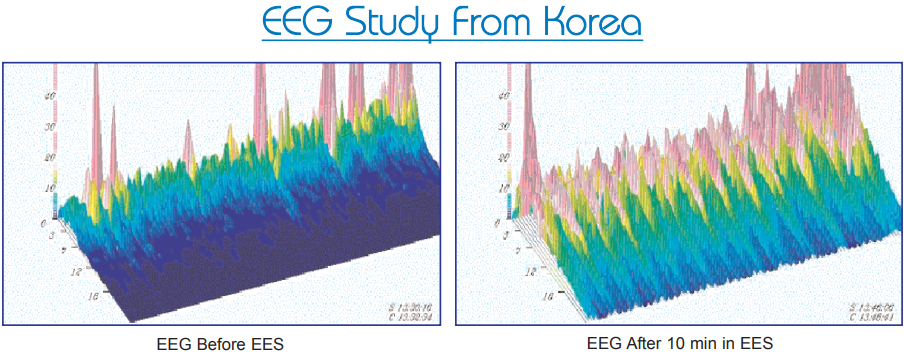
A one-page research brief labeled “EEG Study From Korea” presents side-by-side EEG surface plots comparing “EEG Before EES” vs. “EEG After 10 min in EES.” The visuals are framed as increased brain activity after short exposure, positioning EEG coherence and power-spectrum tracking as practical next-step metrics for standardized, repeatable field-environment research.
A new EEG-focused visual brief is drawing attention because it makes a bold research claim in a format scientists can actually test: measure the brain, then measure it again after exposure, and compare the signal.
The document—titled “EEG Study From Korea”—shows two 3D-style EEG surface plots labeled “EEG Before EES” and “EEG After 10 min in EES.” The accompanying caption states that the “after” image reflects an increase in brain activity with just a 10-minute exposure to the EES, and notes that the EEG work was “researched by scientists” and “featured in spas in Korea.”
WHAT THE VISUALS SHOW
On page 1, the paired EEG plots present an apparent shift from a lower, calmer-looking surface to a more elevated, higher-amplitude landscape after 10 minutes. The document interprets this as increased brain activity—an interpretation that, if supported by raw EEG data, could be evaluated through standard quantitative EEG methods (power spectrum, band distribution, and coherence metrics).
WHY EEG IS A STRONG RESEARCH TOOL HERE
EEG stands out in “field-environment” claims because it’s:
FAST (changes can be tracked minute-by-minute)
REPEATABLE (same participant, repeated sessions)
QUANTIFIABLE (frequency bands, coherence, amplitude, variability)
If an environment claims to increase “balance” or “activity,” EEG is one of the most direct ways to test those claims without relying on subjective reports alone.
WHAT A CONTROLLED FOLLOW-UP STUDY COULD LOOK LIKE
To turn a compelling before/after image into credible evidence, the next step is protocol discipline. A replication-ready design would typically include:
STANDARDIZED BASELINES
Same time of day, caffeine rules, sleep screening, identical electrode placement, and consistent pre-test rest.
PRIMARY EEG ENDPOINTS
Pre-register specific metrics such as band power (delta/theta/alpha/beta/gamma), coherence between regions, and artifact-free epoch counts.
SHAM OR CONTROL CONDITIONS
Randomized exposure order (EES vs sham room), matched time, matched seating and environment, and blinding where possible.
ARTIFACT CONTROL
Motion, eye-blink, and muscle artifact rejection, plus transparent reporting of data-cleaning methods.
INDEPENDENT REPLICATION
Multiple sites running the same protocol to test whether effects generalize across technicians and equipment.
Categories: Sciences, Educational Technology, Healthcare Technology
Tags: 3D-style, brain activity, EEG, EES, Energy Enhancement System™
Additional Links
Just Going Viral
Founded by Hon. Dr. Sandra Rose Michael, DNM, DCSJ, Energy Enhancement System, LLC is a Nevada-based research and technology company dedicated to the responsible exploration of scalar-field and photonic energy phenomena. The company's mission is to p