
Hudspeth Pre- and Post-Brain Maps Spotlight a Measurement Path for EESystem™ Brain-State Research
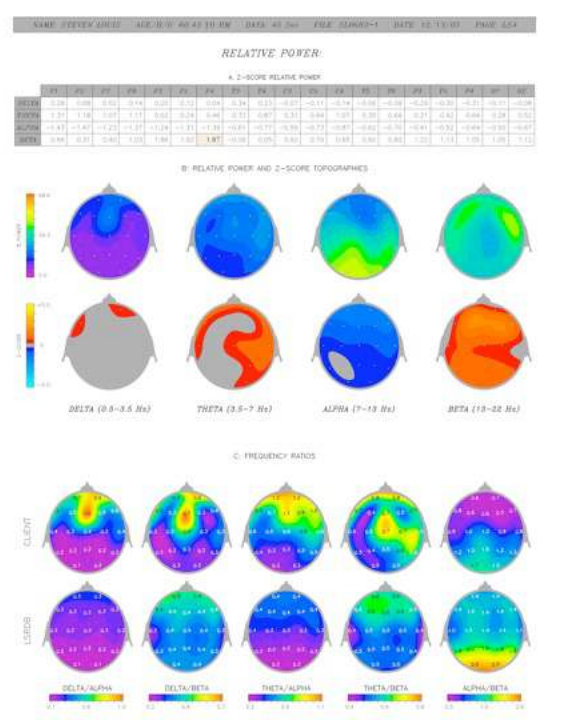
The Hudspeth pre/post brain maps document, associated with Dr. N. White, PhD in Houston, Texas, adds a neuroscience-focused layer to EESystem™ research. The material highlights how brain mapping may help evaluate changes before and after time in a conditioned scalar-field environment, supporting the need for standardized protocols and replication.
Research becomes more powerful when it can be seen, measured, and compared.
The “Hudspeth Pre & Post Brain Maps” document, associated with Dr. N. White, PhD in Houston, Texas, adds an important neuroscience-focused angle to the growing conversation around the Energy Enhancement System™ (EESystem™) and conditioned scalar-field environments.
Rather than relying only on personal experience, pre/post brain mapping points toward a more structured research question: what measurable changes can be observed in brain activity before and after time in an EESystem™ environment?
WHY BRAIN MAPS MATTER
Brain mapping gives researchers a way to visualize patterns in brain activity, regulation, and functional balance. In wellness research, this matters because many reported experiences—deep relaxation, mental clarity, emotional calm, improved focus, or meditative ease—are connected to nervous-system activity.
If participants report that an EESystem™ session feels calming, clarifying, or restorative, brain maps can help researchers ask a better question: does the brain show measurable pattern changes that align with those experiences?
THE RESEARCH QUESTION
The key question is practical: can time in a conditioned scalar-field environment be associated with measurable shifts in brain-state patterns?
A pre/post brain-map format is useful because it creates a clear structure:
Measure the participant before the session.
Introduce the defined environment.
Measure again afterward.
Compare the results.
That framework does not automatically prove cause and effect, but it creates a strong starting point for future controlled research.
WHY THIS IS RESEARCH-WORTHY
Many EESystem™ discussions focus on relaxation, balance, energy, and whole-body coherence. Brain mapping brings the discussion closer to measurable nervous-system response.
This is especially relevant because the brain is highly sensitive to stress, environment, sleep, emotional state, breathing patterns, expectation, sensory input, and meditative focus. Any study of a wellness environment must account for those factors carefully.
That is what makes pre/post brain mapping valuable: it can help separate general subjective experience from observable neurological patterns.
WHAT COULD BE MEASURED NEXT
Future research inspired by the Hudspeth pre/post brain maps could track several categories of brain-state data:
BRAINWAVE PATTERNS
Changes in delta, theta, alpha, beta, and gamma activity can help researchers evaluate relaxation, attention, arousal, and meditative states.
LEFT-RIGHT HEMISPHERE BALANCE
Comparing activity between hemispheres may help researchers explore claims related to coherence, balance, and integration.
REGIONAL ACTIVITY
Mapping different brain regions can help identify whether changes appear globally or in specific areas linked to attention, stress response, emotional regulation, or sensory processing.
COHERENCE AND CONNECTIVITY
Brain-map research can evaluate whether different brain regions appear to communicate in a more organized or synchronized way after exposure.
REPEATABILITY
The most important question is whether similar brain-map patterns appear across repeated sessions, different participants, and different locations.
FROM VISUAL DATA TO STRONGER SCIENCE
Brain maps can be compelling, but visual comparison alone is not enough. Strong follow-up research should convert images into measurable data using clear analysis methods, standardized equipment, and blinded review.
That means researchers should define the primary outcomes before the study begins, use the same measurement conditions each time, and include comparison or control sessions to account for quiet rest, expectation, meditation, and normal variation.
WHAT A STRONGER FOLLOW-UP STUDY COULD INCLUDE
A stronger next-phase study could include:
STANDARDIZED SESSION CONDITIONS
Same session duration, room setup, participant position, lighting, sound level, hydration guidance, and pre-session instructions.
BASELINE CONTROLS
Consistent timing, caffeine rules, sleep screening, stress-level recording, and rest periods before measurements.
CONTROL OR SHAM COMPARISON
Matched sessions in a non-EESystem™ room to help separate the effect of the conditioned environment from quiet rest or expectation.
QUANTITATIVE BRAIN-MAP ANALYSIS
Numerical tracking of brainwave bands, regional activity, coherence, and pre/post statistical changes.
BLINDED DATA REVIEW
Independent reviewers should analyze brain-map outputs without knowing whether the data came from before or after the session.
MULTI-SITE REPLICATION
The same protocol should be repeated across different centers, operators, and participants to determine whether findings remain consistent.
WHY THIS RESEARCH IS ENGAGING
The Hudspeth pre/post brain maps are engaging because they focus on one of the most important frontiers in wellness research: the relationship between environment and the brain.
People often describe certain spaces as calming, restorative, or mentally clearing. Brain mapping gives researchers a way to examine whether those experiences correspond with measurable changes in brain activity.
That makes this document more than a visual comparison. It is a starting point for a deeper research question: can a conditioned scalar-field environment support measurable shifts in neurological regulation?
THE BIGGER RESEARCH OPPORTUNITY
The future of EESystem™ research will depend on measurement.
Brain maps, EEG analysis, HRV, sleep tracking, stress scales, and validated wellness outcomes can help researchers build a clearer picture of how participants respond before and after sessions.
The goal is not simply to confirm belief. The goal is to test the signal, refine the protocol, and determine what can be replicated.
IMPORTANT CONTEXT
This article discusses preliminary and observational research material. It should not be interpreted as medical advice, diagnosis, or proof of treatment efficacy. Any health-related claims involving EESystem™ environments require controlled research, transparent methodology, qualified professional oversight, and independent replication.
Categories: Sciences, Educational Technology, Healthcare Technology
Tags: EEG Research, EESystem™, Hudspeth Brain Maps
Additional Links
Just Going Viral
Founded by Hon. Dr. Sandra Rose Michael, DNM, DCSJ, Energy Enhancement System, LLC is a Nevada-based research and technology company dedicated to the responsible exploration of scalar-field and photonic energy phenomena. The company's mission is to p