
EESystem™ Case Series Tracks “Cellular Millivoltage” Shifts Across 12 Patient Files, Pointing To Next-Step Replication Research
A 2008 case-series brief compiled by Michael S. Cook, D.C., Dipl. Ac. summarizes 12 patient files monitored before and after EES/EESystem™ exposure using meridian-based “cellular millivolt” readings and symmetry targets. The report highlights repeated pre/post graph comparisons—alongside patient-reported changes—while emphasizing the need for standardized protocols and controlled replication.
Research gets interesting when it stops being vague and starts being measurable. A 12-patient case-series brief compiled by Michael S. Cook, D.C., Dipl. Ac. brings that measurement-first mindset to EES/EESystem™ observation—using repeated pre/post graph comparisons and “cellular millivolt” readings to track changes over time.
STUDY SNAPSHOT
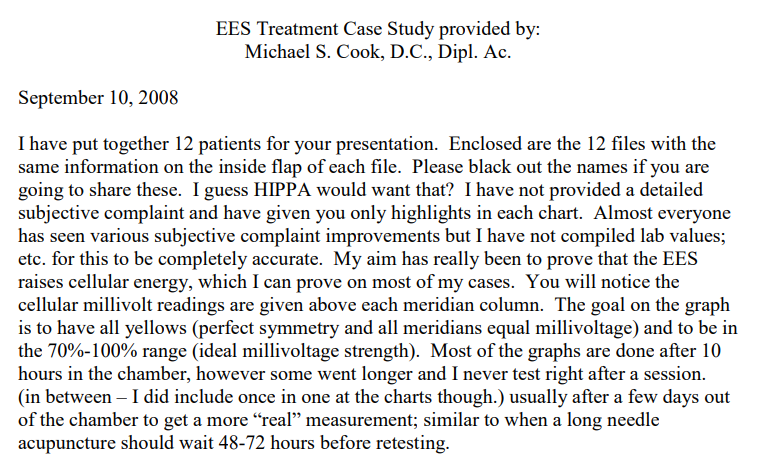
Dated September 10, 2008, the brief assembles 12 individual patient files selected for presentation. The author notes the files were prepared with highlights rather than fully compiled lab datasets, and emphasizes that identities should be removed if shared publicly. Most “Test 1” results were recorded prior to the first EES session, establishing a baseline for comparison.
THE MEASUREMENT METHOD
The core tracking method centers on meridian columns with millivolt readings placed above each column. The stated goal is a profile that trends toward “perfect symmetry” (more “yellows”) and falls within an “ideal” strength range described as 70%–100%. Most follow-up graphs were recorded after approximately 10 hours of chamber exposure, and the author notes that testing typically occurs after time outside the chamber rather than immediately post-session—intended to capture a more stable, real-world measurement.
WHAT THE CASE FILES REPORT
While the document is not a controlled clinical trial, it offers multiple examples where the author reports measurable shifts in readings alongside patient-reported changes. Highlights include:
A stroke history case with left-side paralysis where later tests reportedly showed improved millivoltage symmetry, reduced leg swelling, and greater arm range of motion over time.
A chronic pain and immune weakness case where the initial graph reportedly showed “0 readings,” followed by increased “CHI energy level” after additional chamber exposure, with the patient later reporting enough functional improvement to discontinue wheelchair use and begin physical therapy.
A narcolepsy history case reporting increased alertness and missed medication doses due to feeling more awake.
Chronic renal and blood-pressure concerns described with reports of improved readings, reduced medication needs, and improved GFR notes in the narrative summary.
A lymphoma case undergoing extensive chemotherapy where the patient reportedly described increased energy and improved blood tests, while the author also notes post-chemotherapy drops in scores and repeated liver-related flags in the readings.
WHY THESE OBSERVATIONS ARE ONLY A START
Case series can be valuable—especially when they attempt consistent measurement—but they are also vulnerable to bias and confounding factors. The brief itself acknowledges limits (e.g., not compiling full lab values across cases). This is exactly why the work is best read as hypothesis-generating: it suggests patterns worth testing, not conclusions that are already proven.
A REPLICATION-READY ROADMAP
If researchers want to validate whether the observed patterns reflect a real and repeatable effect, the next step is straightforward—and rigorous:
STANDARDIZE EXPOSURE PARAMETERS (duration, frequency, seating distance, room variables)
DEFINE PRIMARY ENDPOINTS BEFORE TESTING (objective metrics like HRV, sleep measures, blood pressure trends, and lab panels when appropriate)
INCLUDE CONTROL OR SHAM CONDITIONS (matched time and environment)
USE BLINDED REVIEW FOR OUTPUTS (especially any image-based or graph-based interpretation)
REPLICATE ACROSS SITES AND OPERATORS (to confirm the signal is not technician-dependent)
Categories: Sciences, Educational Technology, Healthcare Technology
Tags: cellular millivolt, EESystem™, Michael S. Cook
Additional Links
Just Going Viral
Founded by Hon. Dr. Sandra Rose Michael, DNM, DCSJ, Energy Enhancement System, LLC is a Nevada-based research and technology company dedicated to the responsible exploration of scalar-field and photonic energy phenomena. The company's mission is to p