
1988 Paper Outlines Cellular Mechanisms For “Scalar Energy” Bioeffects—And Reports An In-Vitro Neurotransmitter Signal Worth Replicating
A 1988 conference paper by Dr. Glen Rein (Stanford University Medical Center) examines how non-linear “scalar” fields might interact with living systems, surveying clinical variables, proposing a tissue-culture test bed, and reporting an in-vitro reduction in noradrenaline uptake in nerve cells after 30 minutes of exposure. The work underscores the need for modern dosimetry and independent replication.
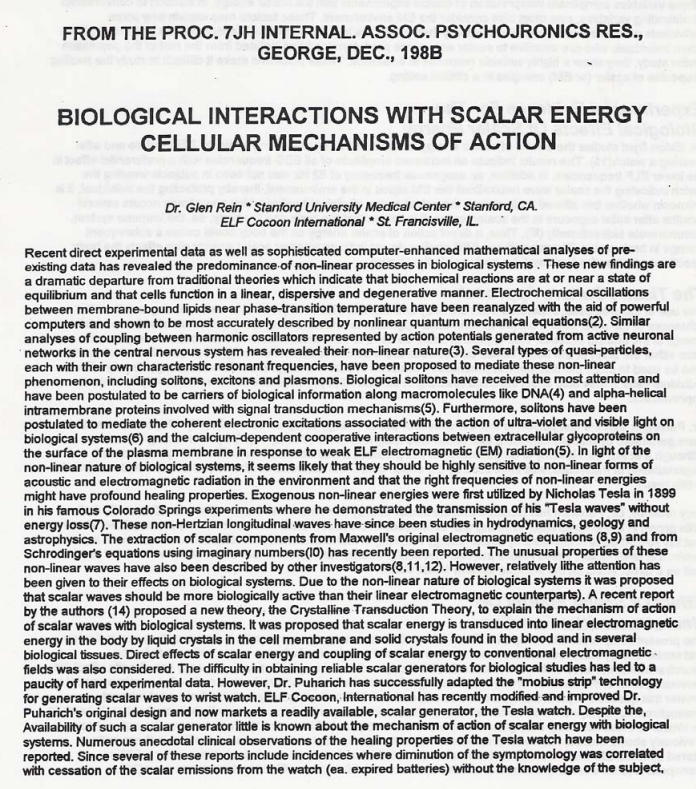
A technical research paper from the late 1980s is resurfacing in today’s coherence-and-biofield conversations for one simple reason: it tries to connect a controversial field hypothesis to measurable biology.
Titled “BIOLOGICAL INTERACTIONS WITH SCALAR ENERGY: CELLULAR MECHANISMS OF ACTION,” the paper (from a 1988 conference proceedings) lays out a research argument that if non-linear processes dominate biological systems, then non-linear field inputs—described here as “scalar”—could plausibly produce detectable effects.
WHY NON-LINEAR BIOLOGY CHANGES THE QUESTION
The paper starts with a premise familiar to many modern systems biologists: living systems often behave non-linearly, especially near transitions between order and disorder. From that lens, the authors propose that subtle, non-linear field interactions might be “amplified” by biological organization in ways that linear models could miss.
WHY THE AUTHORS PUSH FOR CLEANER TESTS
The paper notes a recurring challenge in field-related clinical discussions: real-world outcomes are tangled with confounds—stress levels, moods, beliefs, environmental EM exposure, and individual sensitivity. Even if reported outcomes look compelling, the authors argue you need tighter experimental isolation before you can reasonably claim a direct biological mechanism.
THE TISSUE-CULTURE APPROACH: A RESEARCH RESET BUTTON
To reduce “human variables,” the paper highlights tissue culture as a cleaner proving ground: isolate cells, control the environment, apply exposure, and measure a defined endpoint. This is where the discussion becomes highly actionable for modern replication—because it translates a debated concept into a controlled lab pathway.
THE KEY SIGNAL: NORADRENALINE UPTAKE IN NERVE CELLS
The most concrete experimental section describes nerve-cell tissue culture work measuring radiolabeled noradrenaline uptake—an established proxy for neurotransmitter transporter activity. In the reported setup, cells exposed to the “scalar” condition showed reduced uptake at the 30-minute mark (described as roughly a 20% inhibition), while the 10-minute exposure showed no meaningful change. The authors frame this as time-dependent and statistically significant in their dataset, and they connect the mechanism to how certain antidepressants function by altering neurotransmitter reuptake.
MECHANISM IDEAS: FROM “CRYSTALLINE TRANSDUCTION” TO MEMBRANE STRUCTURE
Beyond the results, the paper proposes several mechanistic possibilities—especially the idea that structured components in biology (including membrane organization and liquid-crystal-like behavior) might mediate how a non-linear field translates into biochemical effects. Whether these hypotheses hold up or not, they serve an important purpose: they generate testable predictions for follow-up study design.
WHAT RESEARCHERS CAN TEST NEXT
If a modern lab were to pick this up and test it with today’s standards, the replication roadmap is clear:
STANDARDIZED FIELD CHARACTERIZATION
Quantify the exposure condition (frequency content, intensity, spatial gradients, and environmental artifacts).
BLINDED HANDLING AND SHAM CONTROLS
Randomize samples and add sham devices/conditions to isolate expectancy and handling effects.
DOSE-RESPONSE DESIGN
Vary distance, duration, and exposure timing to confirm the reported time dependence.
MULTI-ENDPOINT VALIDATION
Pair uptake assays with additional cellular readouts (viability, membrane potential, oxidative stress markers, transporter expression).
INDEPENDENT MULTI-SITE REPLICATION
Repeat the same protocol across different labs and equipment to validate generalizability.
Categories: Sciences, Educational Technology, Healthcare Technology
Tags: Dr. Glen Rein, scalar, Stanford University Medical Center
Just Going Viral
Founded by Hon. Dr. Sandra Rose Michael, DNM, DCSJ, Energy Enhancement System, LLC is a Nevada-based research and technology company dedicated to the responsible exploration of scalar-field and photonic energy phenomena. The company's mission is to p